Book Direct, But Who Captures the Value?
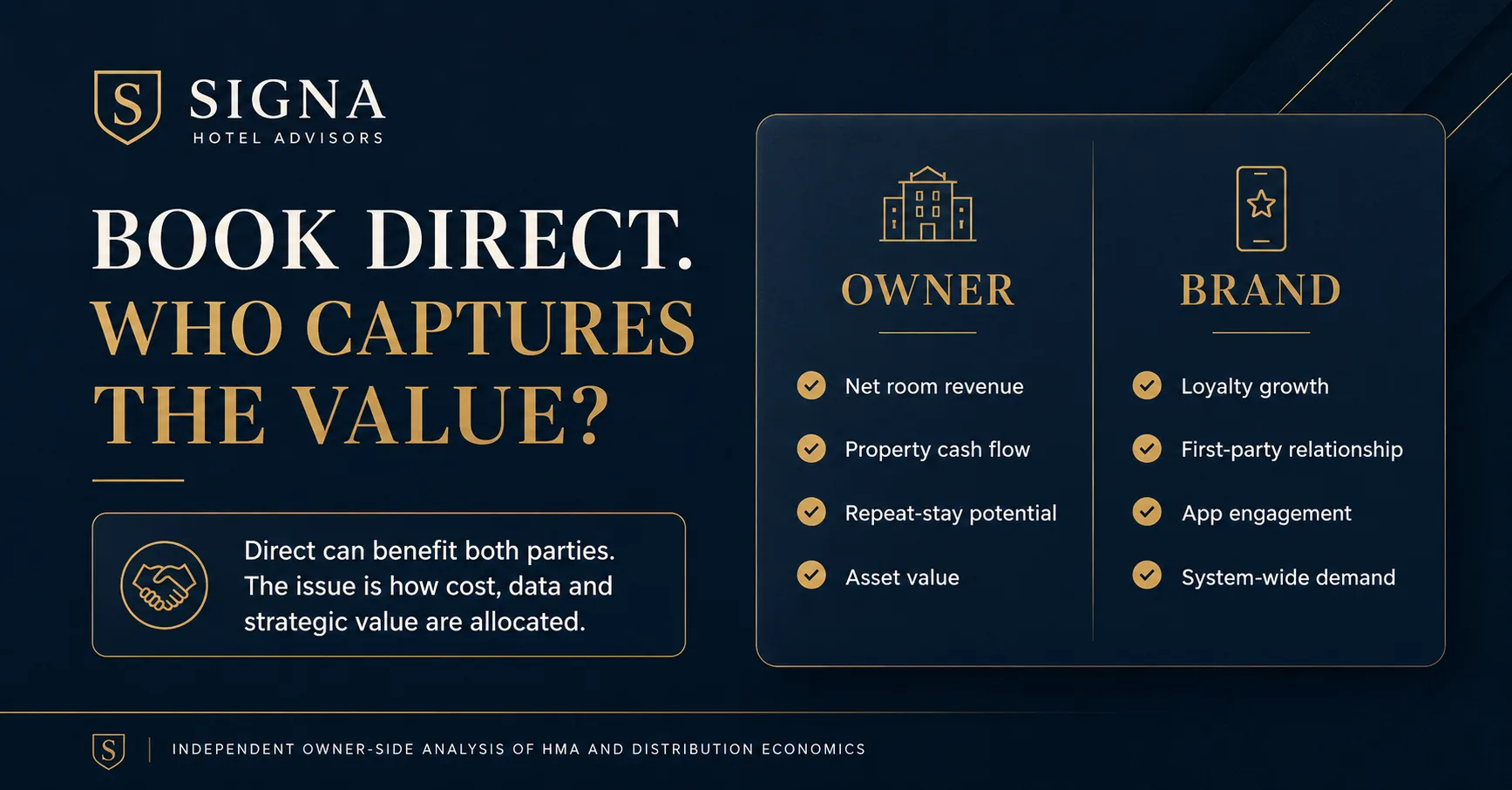
Answer in brief: Direct bookings can benefit both the hotel owner and the brand, but the value is not captured in the same way. The owner may receive lower channel acquisition cost and better property cash flow. The brand gains loyalty membership, first-party relationships, app engagement, system-wide demand and cross-property marketing value. An HMA should make the owner's cost, data access and property-level return transparent.
Key takeaways
- "Book direct" is usually commercially sensible, but direct is not free.
- The owner and brand can both benefit while capturing different forms of value.
- Channel-specific costs must be separated from fees that apply to all hotel revenue.
- Loyalty and reservation charges may be disclosed contractually while their actual annual cost becomes clear only when volumes and budgets are known.
- Owners should negotiate fee transparency, data rights, budget control and property-level loyalty reporting before signing.
The brand campaign and the owner question
Major hotel groups have spent years encouraging guests to book through brand websites and apps.
Hilton's 2016 "Stop Clicking Around" campaign was described as the largest marketing campaign in the company's 97-year history. It used more than 800 assets in 18 languages and promoted the benefits of booking through Hilton's direct channels.
The strategic logic is clear.
Direct bookings can reduce OTA dependency, build loyalty membership, improve app engagement and give the brand a stronger first-party relationship with the guest.
The owner should ask a second question:
What value does this strategy create for my hotel, what does it cost, and which party retains the long-term benefit?
That is not an argument against direct. It is basic owner governance.
Direct booking creates two types of value
1. Property-level economic value
The hotel owner may benefit from:
- lower marginal acquisition cost than an OTA;
- reduced cancellation in some markets and rate structures;
- better pre-arrival upselling;
- increased ancillary spend;
- stronger communication with the booked guest;
- an opportunity to secure a repeat stay; and
- improved property cash flow.
The size of this value depends on the booking source, discount, reservation charge, loyalty cost, paid-media spend and guest behaviour.
Loyalty cost deserves particular attention; our analysis of what owners should test in a hotel loyalty programme sets out how to check it before signing.
2. Brand-system strategic value
The brand may benefit from:
- loyalty membership growth;
- first-party customer profiles;
- app adoption;
- brand-level remarketing;
- cross-property booking behaviour;
- reduced system-wide OTA dependence;
- stronger direct-channel scale; and
- broader credit-card and commercial-partner economics.
A guest recruited through the owner's hotel may later stay at another property in the brand system. The originating owner funded part of the acquisition, but the lifetime value can circulate across the network.
This does not make the system unfair by definition. The network can also send demand back to the owner's hotel. The issue is whether property-level contribution is measured and whether owner-funded costs are proportionate to the value delivered.
What current loyalty data actually shows
CBRE analysed five major public hotel companies and reported that:
- total loyalty membership grew 14.5% in 2024 to more than 676 million;
- room growth was 6.7%;
- loyalty members accounted for 52.8% of occupied rooms; and
- loyalty-programme fees paid by hotels increased 4.4%, faster than total revenue growth of 2.7%.
These figures demonstrate scale and increasing cost.
They do not prove that every hotel receives a positive loyalty return. The occupancy and fee analysis is primarily based on U.S. hotel data and public company reporting. Property-level ROI still depends on location, brand, guest mix, rate discount, redemption reimbursement and elite benefit cost.
The correct owner question is not whether the loyalty programme is large.
It is whether the specific hotel receives sufficient incremental revenue and profit for the cost it bears.
The fee stack needs two separate views
A recurring problem in HMA discussions is that two different analyses are merged.
View 1: Incremental channel economics
This asks which costs change because the booking is direct rather than OTA.
For direct bookings, these may include:
- reservation or CRS transaction fees;
- payment processing;
- property-funded paid media;
- metasearch;
- loyalty assessments;
- member discounts;
- call-centre fees;
- elite benefits; and
- redemption economics.
For OTA bookings, these may include:
- commission;
- higher commission for visibility programmes;
- hotel-funded OTA promotions;
- payment charges;
- sponsored placement; and
- cancellation wash.
This view supports channel strategy.
View 2: Full owner economics
This asks what the owner pays under the HMA, brand arrangement and annual operating budget.
It may include:
- base management fee;
- incentive management fee;
- brand, licence or royalty assessments;
- marketing funds;
- core technology and PMS;
- loyalty and reservation programmes;
- regional and cluster charges;
- quality assurance;
- training;
- procurement;
- accounting allocations; and
- reimbursable expenses.
This view supports HMA negotiation, budgeting and asset valuation.
The costs in View 2 are real. They should not automatically be charged only to direct bookings if they also apply to OTA revenue.
What current HMA data says
JLL and Baker McKenzie's 2024 Asia Pacific HMA survey reported:
- an average base management fee of approximately 1.6% of revenue; and
- an average incentive fee of approximately 6.6% of GOP or adjusted GOP.
HVS separately notes that traditional management agreements often use a base fee of 2% to 4% of total operating revenue, with 3% common in the agreements it reviewed.
These are market references, not a substitute for the actual contract.
A specific hotel may also carry reservation, loyalty, technology, marketing and shared-service charges outside the headline base and incentive fees.
The owner's mistake is to negotiate the headline fee aggressively while leaving the wider system economics under-modelled.
Are the extra fees hidden?
Usually not in the literal sense.
They may appear in:
- HMA schedules;
- brand standards;
- central-services agreements;
- reservation or loyalty programme documents;
- technical-services agreements;
- licence agreements;
- pre-opening budgets;
- annual operating budgets; and
- operator policies incorporated by reference.
The real issue is under-specification and under-modelling.
At signing, the owner may know that participation is mandatory but not know the eventual annual amount because it depends on:
- room revenue;
- member penetration;
- reservation volume;
- systems selected;
- programme changes;
- currency;
- regional allocations; and
- future operator budgets.
The first annual budget can therefore reveal the cash impact more clearly than the term sheet did, even where the legal right to charge was already documented.
Guest data is not a simple ownership question
It is too absolute to say that the brand "owns the guest" and the hotel owner receives no relationship.
The actual position depends on:
- the HMA and related data agreements;
- the loyalty programme terms;
- privacy law;
- who acts as data controller or processor;
- brand and property systems;
- marketing consent;
- permitted use;
- cybersecurity obligations; and
- post-termination rights.
The owner may receive guest stay data and operational access while the brand retains control of the loyalty profile and system-wide marketing relationship.
In Thailand, PDPA compliance must also be considered. Contractual access does not create unlimited marketing rights.
The owner should negotiate specific answers rather than rely on the phrase "guest data ownership."
A corrected booking example
Assume a guest pays USD 150 for one room night.
An OTA booking with 18% commission produces USD 123 before any hotel-paid card cost and before shared operating or HMA expenses.
A branded direct booking might carry:
- 2% card processing;
- USD 5 reservation transaction;
- 2% loyalty assessment; and
- 3% attributable paid media.
That would produce USD 134.50 before shared operating or HMA expenses.
Direct wins by USD 11.50 in that illustration.
If the hotel also bears card cost on the OTA booking, the direct advantage rises to USD 14.50. If paid-direct media, transaction fees or owner-funded loyalty benefits are higher, the advantage falls.
The original version of this article produced only a USD 4 advantage because it charged base management, marketing, technology and royalty costs only to direct.
That comparison was incorrect. Shared costs must be treated consistently.
What the owner should demand before signing
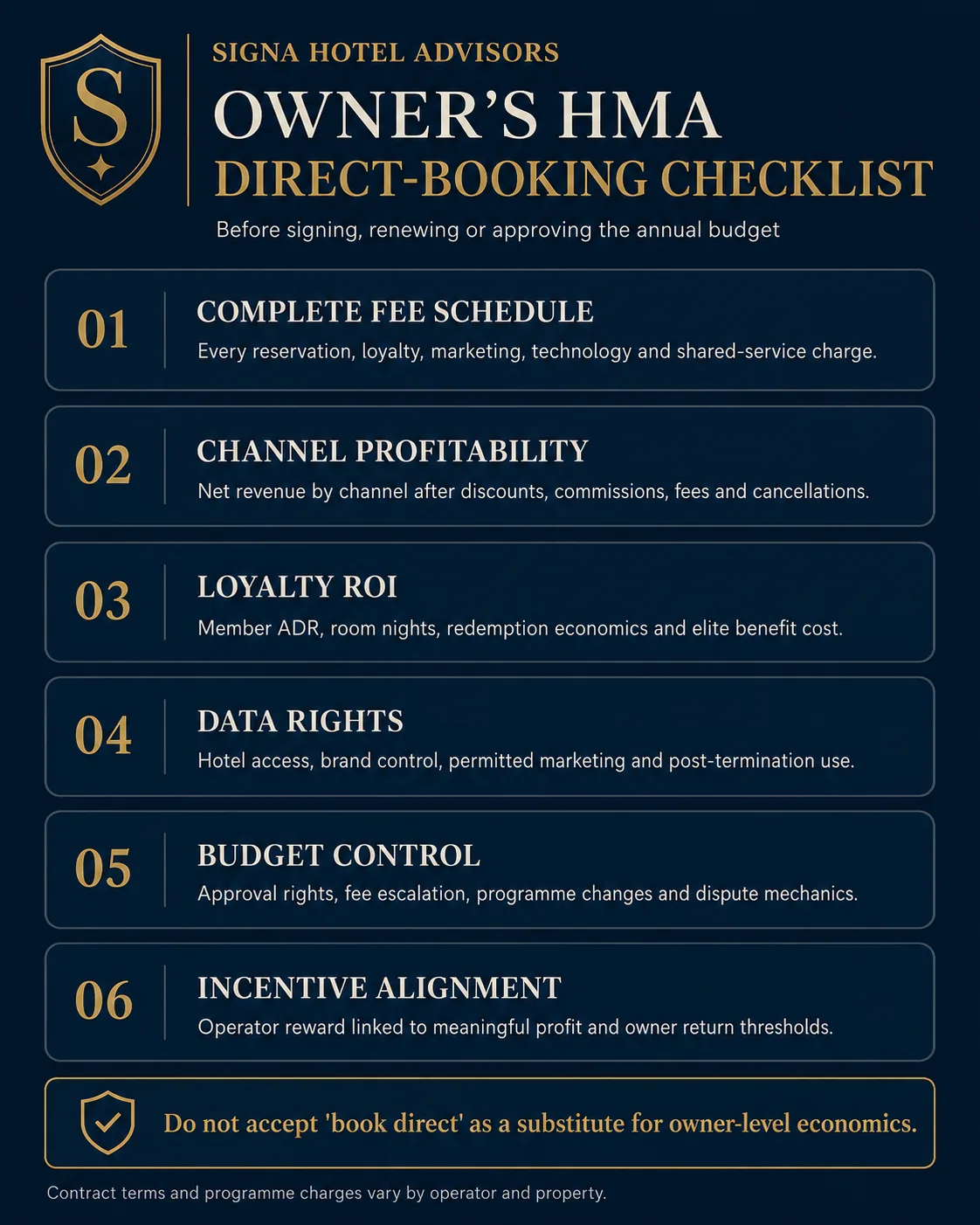
1. A complete fee inventory
Require every fee, assessment and reimbursement category, including:
- formula;
- charging basis;
- currency;
- indexation;
- allocation method;
- approval rights;
- audit rights; and
- historical examples from comparable hotels.
"Central services as determined from time to time" is not a sufficient financial model.
2. A ten-year all-in owner model
The model should include:
- base and incentive fees;
- reservation and loyalty cost;
- technology;
- marketing funds;
- pre-opening and technical services;
- cluster allocations;
- required CapEx;
- FF&E reserve;
- key money or operator contribution;
- taxes;
- debt service; and
- exit assumptions.
The owner should see both gross hotel performance and cash flow after the full operator and brand stack.
3. Monthly channel-profitability reporting
Require reporting of:
- gross pickup;
- cancellations;
- stayed room revenue;
- ADR;
- commission;
- direct acquisition spend;
- reservation cost;
- loyalty cost;
- payment cost;
- member discount;
- elite benefit cost; and
- net revenue by channel.
A percentage of direct bookings is not a profitability metric.
4. Property-level loyalty ROI
Request:
- member room nights;
- member versus non-member ADR;
- member cancellation;
- new enrolments attributed to the hotel;
- redemption nights;
- reimbursement;
- elite benefit cost;
- repeat stays at the same property; and
- incremental demand during low periods.
Brand-level membership growth does not answer the property question.
5. Fee-change and budget controls
The owner should negotiate:
- notice of programme changes;
- budget approval;
- caps where commercially achievable;
- benchmarking;
- audit rights;
- dispute mechanisms; and
- consultation or approval for material new charges.
Not every operator will accept a hard cap. The agreement should still define a process for material escalation.
6. Data access and termination rights
Specify:
- data available to the hotel and owner;
- reporting frequency;
- permitted property marketing;
- privacy responsibilities;
- data export;
- retention;
- transition support; and
- rights after termination or sale.
7. Incentive-fee alignment
It is too simplistic to state that every incentive fee should be payable only after debt service.
Debt structures are owner-specific, and operators commonly resist being subordinated to financing decisions they do not control.
More realistic negotiation options may include:
- adjusted GOP thresholds;
- owner priority return;
- performance hurdles;
- scaled incentive percentages;
- no incentive below an agreed margin;
- treatment of FF&E reserve; and
- exclusions for unsupported central charges.
The objective is meaningful alignment, not a clause that sounds strong but cannot be negotiated or administered.
What a strong asset manager should test annually
The asset manager should answer:
- Is direct still producing better net contribution by segment and booking window?
- Which direct bookings are organic and which require paid acquisition?
- What is the total loyalty cost per stayed member room?
- Are redemption reimbursements commercially adequate?
- Are elite benefits creating measurable retention or only property cost?
- Have central reservation, technology or marketing charges increased faster than revenue?
- Has the operator introduced a new mandatory programme?
- Does the owner have sufficient data to verify the operator's claims?
- Is the brand generating incremental demand during periods when the hotel needs it?
- Would the asset perform better under another operating or affiliation model?
The balanced conclusion
"Book direct" is not a brand trick and it is not automatically an owner windfall.
It is a distribution strategy that can create value for both parties.
The brand gains strategic value across the system. The owner should receive property-level economic value sufficient to justify the fees, discounts and operating obligations it funds.
The governance failure occurs when the hotel reports direct-booking growth without reporting net contribution, loyalty cost, data access and the wider HMA economics.
The correct owner position is not "direct is bad."
It is:
Show me the property-level return, disclose the full cost, and align the contract with the value each party receives.
Related revenue-management analysis
Read ARCC Group's companion article: The True Cost of a Direct Booking — A Revenue Manager's View
Sources and methodology
Facts were reviewed on 14 June 2026.
- CBRE: Hotel loyalty programmes, membership and owner cost
- CBRE: Key findings from more than 675 million loyalty members
- JLL: Asia Pacific HMA fee trends
- Baker McKenzie: Asia Pacific HMA survey
- HVS: Typical hotel management fee structure
- Hilton direct-booking campaign background
- Hospitality ON: Hilton campaign assets and languages
Signa Hotel Advisors provides independent hotel asset management, HMA review and owner representation across Thailand, Southeast Asia and Europe.
Continue reading
- Reviewing Your Annual Hotel Budget: An Owner's Checklist
- 10 Numbers Every Hotel Owner Should Check in the Monthly Report
- Capture, Not Dwell: What the RevPAG Argument Misses in Thailand
- The Budget That Arrives After You Sign: What Hotel Owners Are Never Told About Brand Costs
- Hotel Loyalty Programmes: What Owners Need to Test Before Signing
- Hotel Operator Selection in Thailand: An Owner's Guide
- Hotel Feasibility Study in Thailand: An Investor's Guide
- Hotel Asset Management in Thailand: An Owner's Guide
- Signa hotel asset management & HMA review services
- The True Cost of a Direct Booking — A Revenue Manager's View
Need a confidential review of your hotel?
Signa Hotel Advisors represents hotel owners across Thailand and Southeast Asia on asset management, feasibility, operator selection and HMA negotiation.
Speak with our team