Hotel Operator Selection in Thailand: An Owner's Guide
Last reviewed 14 June 2026
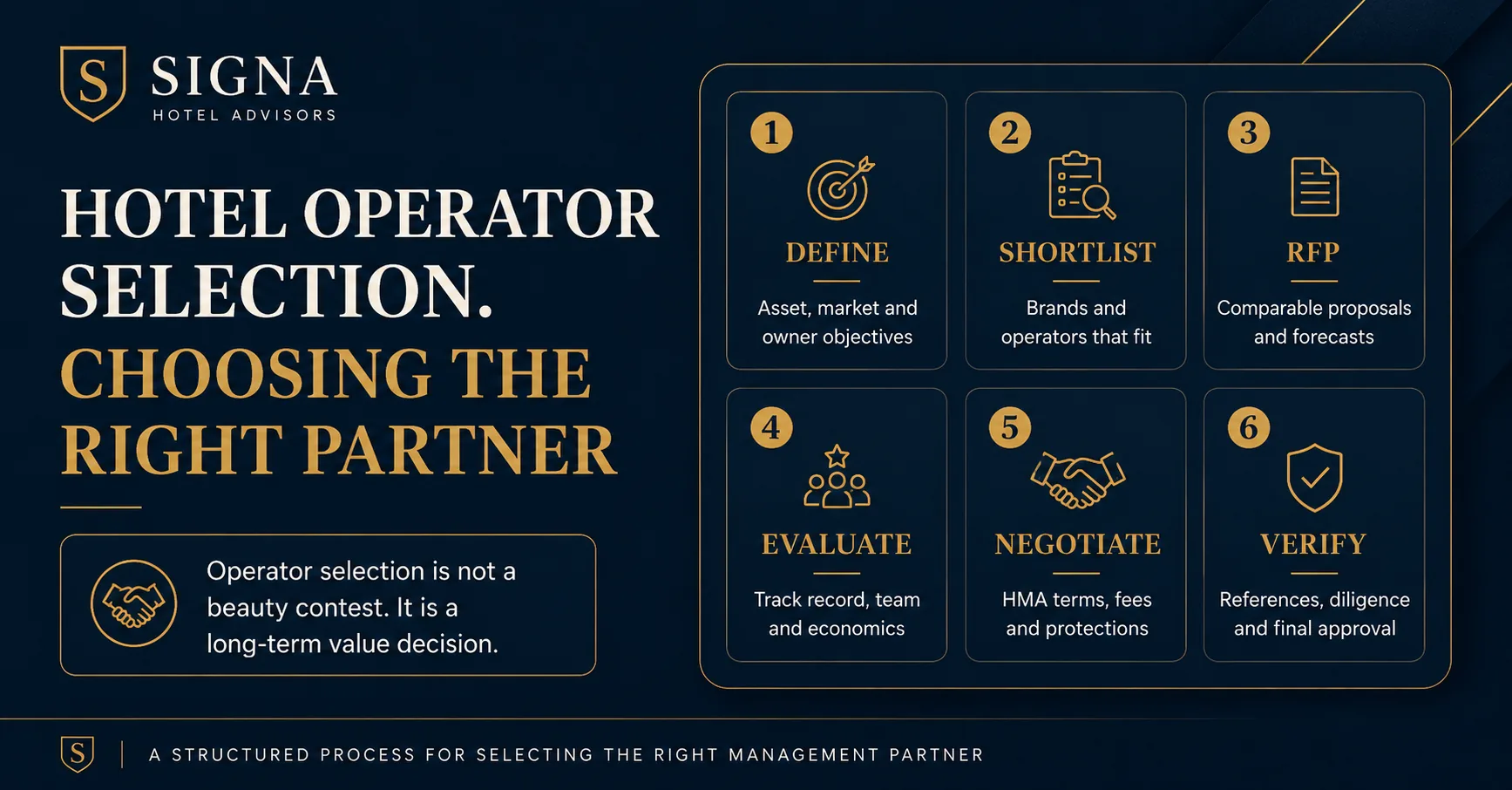
Answer in brief: Hotel operator selection is a structured procurement and negotiation process. The owner should define the investment brief, compare suitable operating models, issue a consistent request for proposal, evaluate comparable-property performance and all-in owner economics, negotiate the HMA, and verify references before appointment. The strongest brand presentation is not necessarily the strongest investment outcome.
Key takeaways
- Decide the operating model before comparing operator names.
- Evaluate net owner cash flow, not only brand recognition or gross revenue forecasts.
- Require every operator to disclose the complete fee and mandatory-programme stack.
- Test comparable-property performance in Thailand and the quality of the proposed local team.
- Treat the HMA as an investment document. Term, budget rights, performance tests, area protection, key money, CapEx obligations and exit rights can affect value for many years.
- Never rely only on the operator's own forecast and pitch materials.
Why operator selection is a high-impact owner decision
A hotel operator affects the asset's market positioning, commercial systems, staffing model, cost base, brand standards, guest profile and long-term saleability.
The relationship is also long. JLL and Baker McKenzie's 2024 Asia Pacific survey found an average initial HMA term of approximately 17.4 years. A weak appointment can therefore impair returns long after the individuals who negotiated it have moved on.
Under an HMA, the operator typically controls day-to-day operations within the agreement and approved budget. The owner normally funds the hotel, bears operating risk and receives the residual cash flow.
The objective is not to select the most famous operator. It is to select the operating model, operator, brand and contractual terms that create the strongest risk-adjusted return for the specific asset.
Step 1: Define the owner brief
Do not approach operators with a vague request to "propose a brand."
The owner brief should define:
Asset and development profile
- location and micro-location;
- new build, conversion, acquisition or repositioning;
- room count and room mix;
- food and beverage, meeting, spa, wellness and other facilities;
- mixed-use components;
- development programme and opening target; and
- current design status and flexibility.
Market and positioning
- target guest segments;
- intended rate position;
- source markets;
- competitive set;
- seasonality;
- brand level; and
- the demand problem the hotel is intended to solve.
Owner investment objectives
- income, capital appreciation or both;
- expected holding period;
- debt constraints;
- target return;
- desired level of owner control;
- willingness to fund brand standards and PIPs;
- exit strategy; and
- whether unencumbered sale flexibility is important.
The brief should also state what is negotiable. Operators will otherwise design proposals around their preferred model rather than the owner's investment priorities.
Step 2: Select the operating model before the operator
The owner should compare operating structures, not only brands.
Traditional HMA
The operator manages the hotel and normally receives base and incentive fees plus system and programme charges. The owner retains the operating risk.
Franchise plus white-label or third-party management
The owner contracts separately with a brand and a management company. This can provide more operating flexibility, but it creates two agreements and two counterparties that must be aligned.
Independent or proprietary operator
The hotel operates without a major international franchise. This may reduce brand costs and increase flexibility, but the owner must test distribution, talent, systems and market credibility carefully.
Lease
The operator or tenant pays rent and takes more operating risk. The owner may sacrifice upside in exchange for more predictable income, subject to tenant covenant and lease terms.
Manchise or conversion structure
Some agreements allow the relationship to convert from management to franchise after defined conditions. These structures require detailed drafting.
JLL expects owners in Asia Pacific to use a wider mix of franchise, manchise and white-label operating models. The correct choice is property-specific.
Step 3: Build a disciplined shortlist and RFP
A shortlist should be broad enough to create competition and narrow enough to allow proper diligence. For many projects, four to six serious candidates is workable, but the number should reflect the asset and market.
The RFP should require every operator to respond to the same questions and assumptions.
Request:
- proposed brand and positioning;
- comparable hotels in Thailand and relevant source markets;
- opening and ramp-up plan;
- ten-year or agreed-period operating forecast;
- occupancy, ADR, RevPAR and market-penetration assumptions;
- staffing and payroll model;
- food and beverage strategy;
- pre-opening budget;
- technical-services scope and fees;
- full management, brand, system and programme fee schedule;
- loyalty and direct-channel contribution evidence;
- key executive and regional support structure;
- HMA commercial terms;
- required owner CapEx and brand standards;
- area protection;
- performance test;
- key money or financial contribution;
- termination and sale provisions; and
- owner references.
Do not allow each operator to use different market, inflation or opening assumptions without a reconciliation. Otherwise the forecasts are not comparable.
Step 4: Evaluate what predicts owner performance
1. Comparable-property track record
Global portfolio size is not enough.
Request evidence from hotels that are comparable in:
- destination;
- demand mix;
- scale;
- positioning;
- facilities;
- opening period; and
- ownership structure.
Useful evidence includes RevPAR index, GOP margin, ramp-up performance, budget accuracy, guest metrics and staff turnover. Operators may restrict property-level disclosure, but they should still provide credible, verifiable evidence.
2. Net owner economics
Compare the full owner P&L under one consistent operating scenario.
The 2024 JLL and Baker McKenzie Asia Pacific survey reported average base fees of approximately 1.6% of revenue and average incentive fees of approximately 6.6% of GOP or adjusted GOP. These are survey averages, not pricing benchmarks for a specific Thai deal.
The comparison must also include:
- reservation and distribution fees;
- loyalty charges;
- marketing funds;
- technology and licence fees;
- regional and cluster charges;
- reimbursable expenses;
- procurement economics;
- technical-services fees;
- pre-opening fees;
- required PIP or brand investment; and
- owner-funded central initiatives.
A lower headline management fee can still produce a higher all-in cost.
3. Revenue management and distribution capability
Ask the operator to explain how it would manage the actual hotel, not its global system in general.
Test:
- market segmentation;
- pricing and restriction strategy;
- direct-channel economics;
- OTA and wholesale dependence;
- group displacement;
- source-market development;
- low-season strategy;
- length-of-stay controls; and
- revenue-management staffing and decision authority.
The operator should demonstrate how its systems translate into net revenue and profit for comparable Thai properties.
4. Local team and execution capacity
A strong brand with a weak local team is a weak appointment.
Assess:
- regional leadership;
- proposed general-manager profile;
- Thailand commercial support;
- finance, HR, engineering and pre-opening resources;
- cluster-service model;
- decision speed; and
- staff recruitment and retention capability.
The owner should know who will actually support the hotel after signing.
5. Reporting and owner transparency
Confirm:
- weekly and monthly reporting;
- access to source data;
- forecast frequency;
- owner meeting calendar;
- business-review format;
- budget timetable;
- audit rights;
- system access; and
- escalation procedures.
Transparency promised during the pitch must appear in the HMA.
6. References and owner behaviour
Speak directly with owners of comparable hotels.
Ask:
- Were forecasts realistic?
- Were pre-opening costs controlled?
- Were central fees transparent?
- Did the operator respond effectively when performance missed budget?
- Was the regional office available?
- Were brand standards commercially sensible?
- Were disputes handled constructively?
- Would the owner appoint the operator again?
Step 5: Negotiate the HMA as an investment document
Term and renewal
The HMA term affects flexibility, refinancing and exit value. The owner should test the initial term, renewal options, operator conditions and the effect of the agreement on a future sale.
Base and incentive fees
The fee structure should reward performance that matters to ownership.
Consider:
- a lower base fee;
- sliding incentive fees;
- GOP or adjusted-GOP thresholds;
- an owner priority or return hurdle;
- FF&E reserve treatment;
- caps or controls on central-service charges; and
- no incentive fee when agreed owner-return conditions are not met.
JLL notes that incentive fees based on cash flow after debt service or owner priority are not yet common across Asia Pacific. They are negotiation options, not market defaults.
Budget approval and owner rights
The HMA should define:
- what requires owner approval;
- what the operator may spend without approval;
- how budget disputes are resolved;
- whether the prior-year budget rolls forward;
- emergency-spending rights;
- staffing and key-position consultation;
- capital-expenditure approval; and
- approval of related-party or central charges.
A nominal approval right is not useful if the dispute mechanism automatically favours the operator.
Performance termination
More than 90% of agreements surveyed by Baker McKenzie and JLL contained a performance-termination provision, commonly using RevPAR against a competitive set and GOP against budget.
The details determine whether the clause works.
Review:
- test commencement year;
- single or dual test;
- threshold;
- two-year measurement period;
- competitive-set changes;
- budget manipulation risk;
- force-majeure exclusions;
- operator cure rights;
- cure amount; and
- maximum number of cures.
A performance test that can be repeatedly cured or easily suspended may provide little practical protection.
Key money and operator contributions
Key money can help fund development, conversion or pre-opening costs, but it is not free capital.
The 2024 Asia Pacific survey found operator financial contributions in approximately 22% of surveyed agreements outside Australia, while Baker McKenzie reported key money in 65% of Australian contracts in its 2025 comparison.
The owner should model:
- repayment or clawback;
- amortisation;
- increased term;
- fee trade-offs;
- termination restrictions;
- brand-standard commitments; and
- the effect on sale flexibility.
A larger contribution can be exchanged for weaker economics elsewhere.
Area protection and brand competition
The agreement should define where the operator may open competing brands, which brands are restricted, how the protected area changes, and what remedies apply.
A narrow clause that protects only the exact brand may not protect the hotel from a closely competing sister brand.
PIP, design and brand standards
The owner should quantify:
- initial technical and design requirements;
- opening standards;
- ongoing brand changes;
- renovation cycle;
- approval process;
- value-engineering rights;
- sustainability requirements; and
- responsibility for cost and disruption.
PIP and conversion costs can be material or multimillion-dollar. The cost must be estimated for the actual property rather than described with a generic per-room allowance.
Termination, sale and change of control
Review:
- termination for cause;
- performance termination;
- sale-linked termination;
- change-of-control restrictions;
- operator consent;
- liquidated damages;
- key-money repayment;
- transition assistance;
- data ownership; and
- staff and system handover.
A long HMA can reduce the buyer pool if a purchaser cannot obtain the operating model it requires.
Step 6: Complete due diligence before appointment
Before signing:
- Verify references.
- Reconcile all operator forecasts to one owner model.
- Review the HMA, technical-services agreement, licence agreement and all schedules together.
- Quantify the full all-in cost.
- Confirm the proposed local support team.
- Complete legal, tax, technical and development review.
- Document every commercial point agreed in the final contracts.
- Confirm the owner's governance and reporting process from pre-opening onward.
Common operator-selection mistakes
- Choosing the brand before defining the investment brief
- Comparing gross revenue instead of net owner cash flow
- Accepting an operator forecast without independent feasibility analysis
- Negotiating only the headline management fee
- Ignoring central, loyalty, technology and reimbursable charges
- Treating key money as free capital
- Accepting an ineffective performance test
- Failing to test the local team
- Allowing the HMA to restrict sale or refinancing without modelling the impact
- Conducting owner references after commercial terms are already agreed
Frequently asked questions
Should a Thai hotel always use an international brand?
No. The decision depends on source markets, financing, distribution, product, owner capability and all-in economics. An international brand may add material value, limited value or negative value depending on the asset.
How many operators should receive the RFP?
There is no mandatory number. A focused shortlist of four to six credible candidates is often manageable, but the correct number depends on the project.
Is the cheapest operator usually the best choice?
No. Compare net owner cash flow, capital requirements, contract flexibility, team quality and execution risk.
Are performance tests standard in HMAs?
They are very common in Asia Pacific, but their practical value varies. Thresholds, exclusions and cure rights must be negotiated carefully.
Is key money beneficial to the owner?
It can be, but only after modelling the term, fee, repayment, clawback and exit consequences.
When should operator selection begin?
For a new development, begin early enough for operator input to influence concept, design and financing, but not before the owner has an independent brief and feasibility case.
Our guide to hotel feasibility studies in Thailand explains what that independent case should test before operators are approached.
Conclusion
Hotel operator selection is not a brand beauty contest.
It is a controlled process for choosing the operating model and partner that best serve the owner's investment. The decision should be based on market fit, comparable performance, net owner economics, local execution capacity and contractual protection.
The operator will manage the hotel. The owner must ensure the agreement manages the operator.
Sources and methodology
HMA and market references were reviewed on 14 June 2026.
- JLL and Baker McKenzie: Asia Pacific HMAs average 17 years
- JLL: The Evolving Landscape of Hotel Management Agreements in Asia Pacific
- Baker McKenzie: Australian HMA terms compared with Asia Pacific
- Baker McKenzie: Performance termination, fact or fiction
- HVS: Evolution of Hotel Management Agreements and Alternative Agreements
- JLL: Hotel Management Agreement and the Way Forward
Signa Hotel Advisors provides independent hotel operator selection, brand evaluation and HMA negotiation support across Thailand and Southeast Asia. Contact Signa before issuing an RFP or agreeing operator commercial terms.
Continue reading
- Reviewing Your Annual Hotel Budget: An Owner's Checklist
- 10 Numbers Every Hotel Owner Should Check in the Monthly Report
- Capture, Not Dwell: What the RevPAG Argument Misses in Thailand
- The Budget That Arrives After You Sign: What Hotel Owners Are Never Told About Brand Costs
- Hotel Loyalty Programmes: What Owners Need to Test Before Signing
- Book Direct, But Who Captures the Value?
- Hotel Feasibility Study in Thailand: An Investor's Guide
- Hotel Asset Management in Thailand: An Owner's Guide
- Signa hotel operator selection & HMA negotiation services
Need a confidential review of your hotel?
Signa Hotel Advisors represents hotel owners across Thailand and Southeast Asia on asset management, feasibility, operator selection and HMA negotiation.
Speak with our team