Hotel Asset Management in Thailand: An Owner's Guide
Last reviewed 14 June 2026
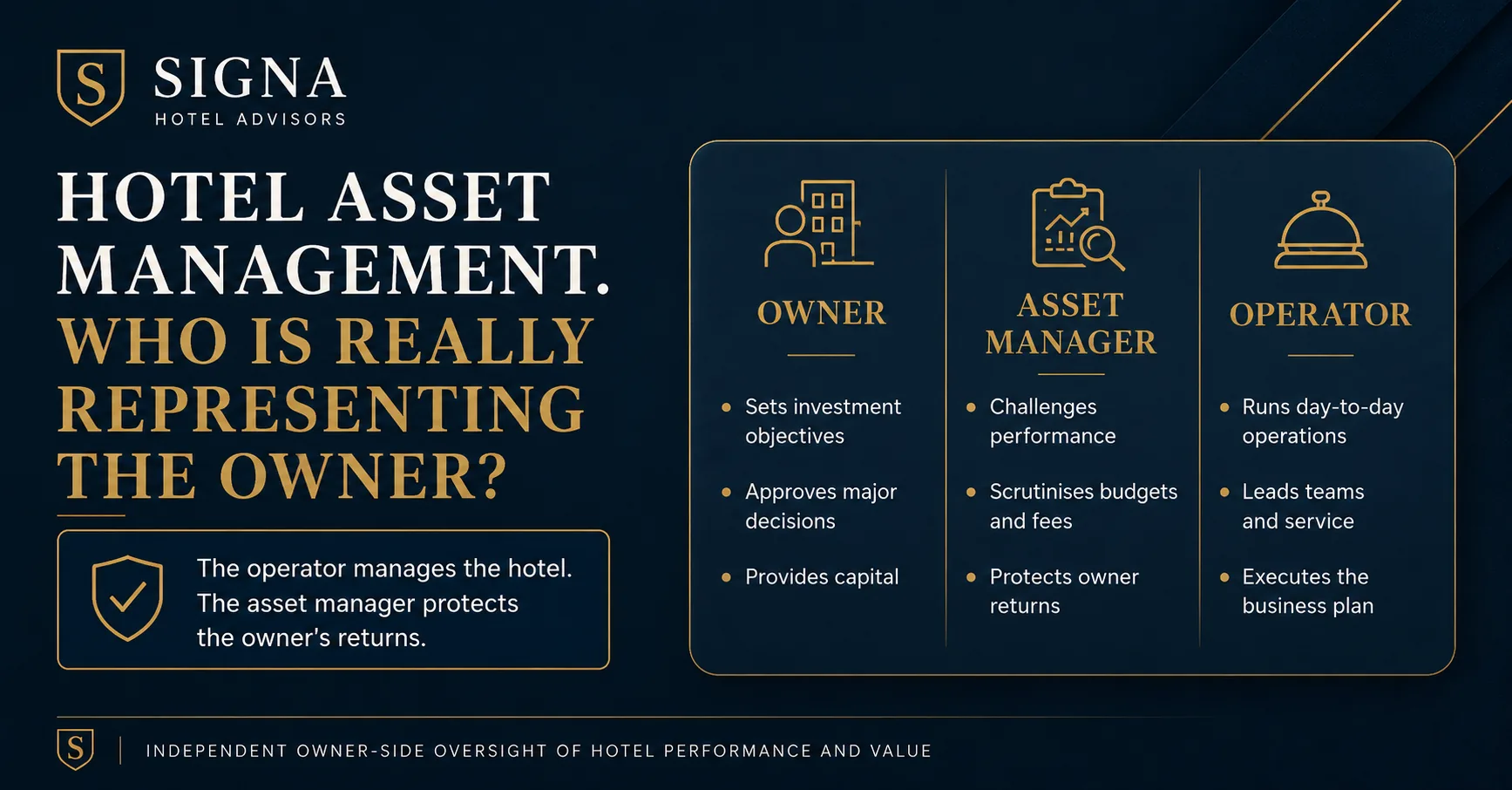
Answer in brief: Hotel asset management is independent oversight carried out on behalf of the hotel owner. The asset manager does not replace the general manager or operate the hotel day to day. The role is to protect owner returns by challenging performance, scrutinising budgets and fees, directing capital priorities, enforcing the Hotel Management Agreement (HMA), and keeping the operator aligned with the owner's investment objectives.
Key takeaways
- The hotel operator runs the business. The asset manager represents the owner.
- Asset management should improve cash flow, asset value and decision quality, not simply produce another monthly report.
- The role is most valuable where an HMA gives the operator broad control, the asset is underperforming, major capital expenditure is planned, or ownership is remote.
- The asset manager's authority depends on the HMA, ownership structure and agreed reporting rights. Real-time access and approval rights should never be assumed.
- In Thailand's increasingly competitive market, passive ownership creates avoidable performance and capital risk.
What is hotel asset management?
Hotel asset management is the professional discipline of managing a hotel's investment performance from the owner's side of the table.
The operator is responsible for running the hotel. That normally includes staffing, service delivery, sales, revenue management, purchasing, maintenance and the guest experience, subject to the HMA and approved budget.
The asset manager focuses on a different question:
Is the hotel being operated and capitalised in a way that maximises sustainable value for the owner?
That distinction matters because the owner and operator are commercial partners, but their incentives are not identical. An operator commonly receives a base fee calculated on revenue and an incentive fee linked to profit. It may also charge or allocate central systems, loyalty, technology, marketing and shared-service costs. The owner carries the investment risk, funds capital expenditure and ultimately receives the residual cash flow.
Independent oversight creates a disciplined counterweight.
Hotel owner, asset manager and operator: who does what?
| Party | Primary responsibility | Typical decisions |
|---|---|---|
| Hotel owner | Investment objectives, capital allocation and major approvals | Hold or sell, debt strategy, major CapEx, HMA approval, ownership return targets |
| Hotel asset manager | Owner representation and investment-performance oversight | Budget challenge, operator accountability, revenue and cost review, CapEx priorities, HMA compliance |
| Hotel operator | Day-to-day hotel operation | Staffing, pricing execution, service delivery, purchasing, maintenance, sales and marketing |
The boundaries are governed by contract. A strong asset manager works through the owner's rights rather than interfering informally in hotel operations.
What does a hotel asset manager actually do?
1. Performance monitoring and operator accountability
The asset manager reviews occupancy, average daily rate (ADR), revenue per available room (RevPAR), total revenue, gross operating profit (GOP), payroll, departmental margins, channel mix and guest metrics.
Performance is tested against:
- the approved annual budget;
- the competitive set;
- previous periods;
- the operator's own forecasts;
- relevant market conditions; and
- the owner's investment plan.
The purpose is not to explain a variance after it has happened. It is to identify what is changing, determine why, and force a clear corrective plan.
For a practical starting point on operator reporting, read 10 Numbers Every Hotel Owner Should Check in the Monthly Report.
2. Annual budget and business-plan review
The annual budget is one of the owner's most important control points.
A proper review should challenge:
- occupancy and ADR assumptions;
- segment and source-market mix;
- payroll and productivity;
- food and beverage profitability;
- utility and maintenance costs;
- sales and marketing expenditure;
- loyalty, reservations, technology and central-service charges;
- management fees and reimbursable costs;
- planned CapEx and FF&E reserve use; and
- the timing and return of major initiatives.
Budget approval rights vary between HMAs. An owner may have full approval rights, qualified approval rights, or only limited consultation rights. The agreement must be read before assuming the owner can reject a cost line.
3. Revenue management and distribution oversight
Hotel performance cannot be assessed from occupancy alone. The asset manager should test whether the hotel is attracting the right demand at the right net contribution.
This includes reviewing:
- pricing and restriction strategy;
- RevPAR index and market penetration;
- direct, OTA, wholesale, corporate and group mix;
- acquisition cost by channel;
- cancellation and no-show patterns;
- promotional dilution;
- room-type and length-of-stay controls; and
- the profitability of packages and loyalty-member rates.
An operator may meet a topline revenue target while missing the owner's profit objective. Asset management connects commercial strategy to net cash flow.
4. Capital expenditure and asset planning
Hotels require continuous reinvestment. The question is not whether to spend, but where, when and why.
The asset manager should maintain a multi-year capital plan covering:
- lifecycle replacement;
- guestroom and public-area renovation;
- plant, mechanical and building systems;
- technology;
- safety and regulatory compliance;
- brand-mandated Property Improvement Plans (PIPs); and
- repositioning opportunities.
Each major project should have a defined purpose, cost, disruption plan and expected return. Brand compliance alone is not an investment case.
5. HMA compliance and full fee scrutiny
The headline base and incentive management fees are only part of the operator's economic cost.
The asset manager should reconcile the HMA and related schedules against actual hotel charges, including:
- central reservation systems;
- loyalty-programme charges;
- brand marketing funds;
- technology and software;
- regional or cluster services;
- training and quality-assurance programmes;
- accounting allocations;
- procurement arrangements; and
- travel and reimbursable expenses.
The review should confirm that every charge is contractually permitted, correctly calculated and supported.
6. Operator, regional team and general-manager management
The asset manager is the owner's principal interface with the operator.
This includes maintaining a constructive but rigorous relationship with the general manager and regional office, documenting decisions, escalating recurring issues, and ensuring that the operator provides the reporting, staffing and corporate support promised under the HMA.
Where the general manager is not delivering, the asset manager should use the owner's contractual consultation or approval rights rather than relying on informal pressure.
7. Refinancing, repositioning and exit strategy
Operational decisions affect valuation.
An asset manager supports refinancing, sale, rebranding, conversion or operator change by producing a clear record of historical performance, normalised earnings, capital requirements, contractual constraints and upside opportunities.
A hotel with strong reporting, credible forecasts and a controlled HMA position is easier to finance and easier to sell.
When does a hotel owner need an asset manager?
Independent asset management is particularly valuable when:
The hotel is operated under an HMA
The operator has broad operational control and the owner carries the investment risk. This is the clearest case for independent oversight.
Performance is below budget or below the competitive set
Persistent underperformance should trigger structured diagnosis, not repeated explanations.
The owner is overseas or not operationally involved
Distance increases information risk. A local owner representative can verify what reports alone cannot show.
A new HMA, renewal or operator transition is approaching
The period before signing is when the owner's negotiating leverage is highest. Asset-management input should begin before commercial terms are agreed.
A major renovation or PIP is planned
The owner needs an independent view of scope, cost, timing, disruption and return.
The asset is being refinanced, repositioned or sold
Investment decisions require normalised earnings, defensible forecasts and a clear assessment of HMA encumbrances.
Why hotel asset management matters in Thailand now
Thailand recorded 32.9 million international visitors in 2025, down 7.2% year on year, while Bangkok's hotel inventory exceeded 83,000 keys after more than 3,000 keys opened in the core CBD during 2025. CBRE described expanding upscale and luxury supply as increasing pressure on older assets and raising the importance of structured, data-led asset management.
The pressure is not uniform. JLL reported that Bangkok RevPAR was broadly stable year on year in the first quarter of 2026, while approximately 5,000 additional rooms were anticipated by year-end. Stable market-level RevPAR does not mean every hotel is stable. New supply, product quality, source-market mix and operating efficiency create widening differences between individual assets.
For owners, the implication is direct: market recovery cannot be relied upon to correct asset-specific weaknesses.
What hotel asset management is not
Hotel asset management is not:
- replacement hotel management;
- a monthly reporting service with no authority or follow-through;
- interference in every operational decision;
- an operator sales representative;
- a guarantee of higher profit regardless of market conditions; or
- a substitute for legal, tax, valuation or technical advice.
The role only works when the mandate, information rights, escalation route and owner objectives are clearly defined.
How to select a hotel asset manager in Thailand
Ask the following questions:
- Whose interests do you represent? Confirm there is no undisclosed operator, brand or vendor conflict.
- Can you read and model the full HMA economics? Operational experience alone is not enough.
- Can you challenge revenue strategy credibly? This requires commercial and distribution expertise.
- What reporting will I receive? The output should identify decisions, actions, owners and deadlines.
- How do you measure your own impact? Agree measurable objectives such as GOP improvement, fee recovery, cost reduction, budget outcomes or CapEx delivery.
- What authority do you require? Clarify access to systems, operator meetings, budgets and contracts.
- What happens when the operator disagrees? The answer should describe a contractual and evidence-based escalation process.
Frequently asked questions
Does an asset manager replace the hotel general manager?
No. The general manager runs the hotel. The asset manager represents ownership and oversees investment performance.
Can a small independent hotel use asset management?
Yes, but the scope should be proportionate. A smaller hotel may use periodic owner-representation, budget review or performance-improvement support instead of a full monthly mandate.
Does an asset manager need access to hotel systems?
The asset manager needs timely access to sufficient operational and financial information. The exact access level depends on the HMA, ownership mandate and data-security controls.
Is hotel asset management only needed when a hotel is underperforming?
No. The highest-value work often occurs before problems appear, particularly during operator selection, budgeting, renovation planning and HMA negotiation.
How is hotel asset management different from hotel consulting?
Consulting is usually project-based. Asset management is an ongoing owner-side governance and performance function, although the same advisory firm may provide both under separate scopes.
Conclusion
The hotel operator manages the business. The asset manager manages the owner's exposure to that business.
For a Thai hotel owner, the value is not another layer of administration. It is independent control over performance, fees, capital and the operator relationship. Where an HMA is long, the capital commitment is material, or the owner is not involved in daily operations, that control is not optional governance. It is part of protecting the investment.
Sources and methodology
Market figures and HMA references were reviewed on 14 June 2026.
- CBRE Thailand: Hotel Asset Management Takes Center Stage, 26 January 2026
- CBRE: Repositioning for Value, The Strategic Role of Hotel Turnarounds in Thailand
- JLL: Bangkok Hotel Market, Q1 2026
- JLL and Baker McKenzie: Asia Pacific HMAs average 17 years
- JLL: What is hotel asset management?
Signa Hotel Advisors provides independent hotel asset management and owner representation across Thailand and Southeast Asia. Contact Signa for a confidential review of your hotel, HMA or operator performance.
Continue reading
- Reviewing Your Annual Hotel Budget: An Owner's Checklist
- 10 Numbers Every Hotel Owner Should Check in the Monthly Report
- Capture, Not Dwell: What the RevPAG Argument Misses in Thailand
- The Budget That Arrives After You Sign: What Hotel Owners Are Never Told About Brand Costs
- Hotel Loyalty Programmes: What Owners Need to Test Before Signing
- Book Direct, But Who Captures the Value?
- Hotel Operator Selection in Thailand: An Owner's Guide
- Hotel Feasibility Study in Thailand: An Investor's Guide
- Signa hotel asset management & owner representation services
Need a confidential review of your hotel?
Signa Hotel Advisors represents hotel owners across Thailand and Southeast Asia on asset management, feasibility, operator selection and HMA negotiation.
Speak with our team