Hotel Feasibility Study in Thailand: An Investor's Guide
Last reviewed 14 June 2026
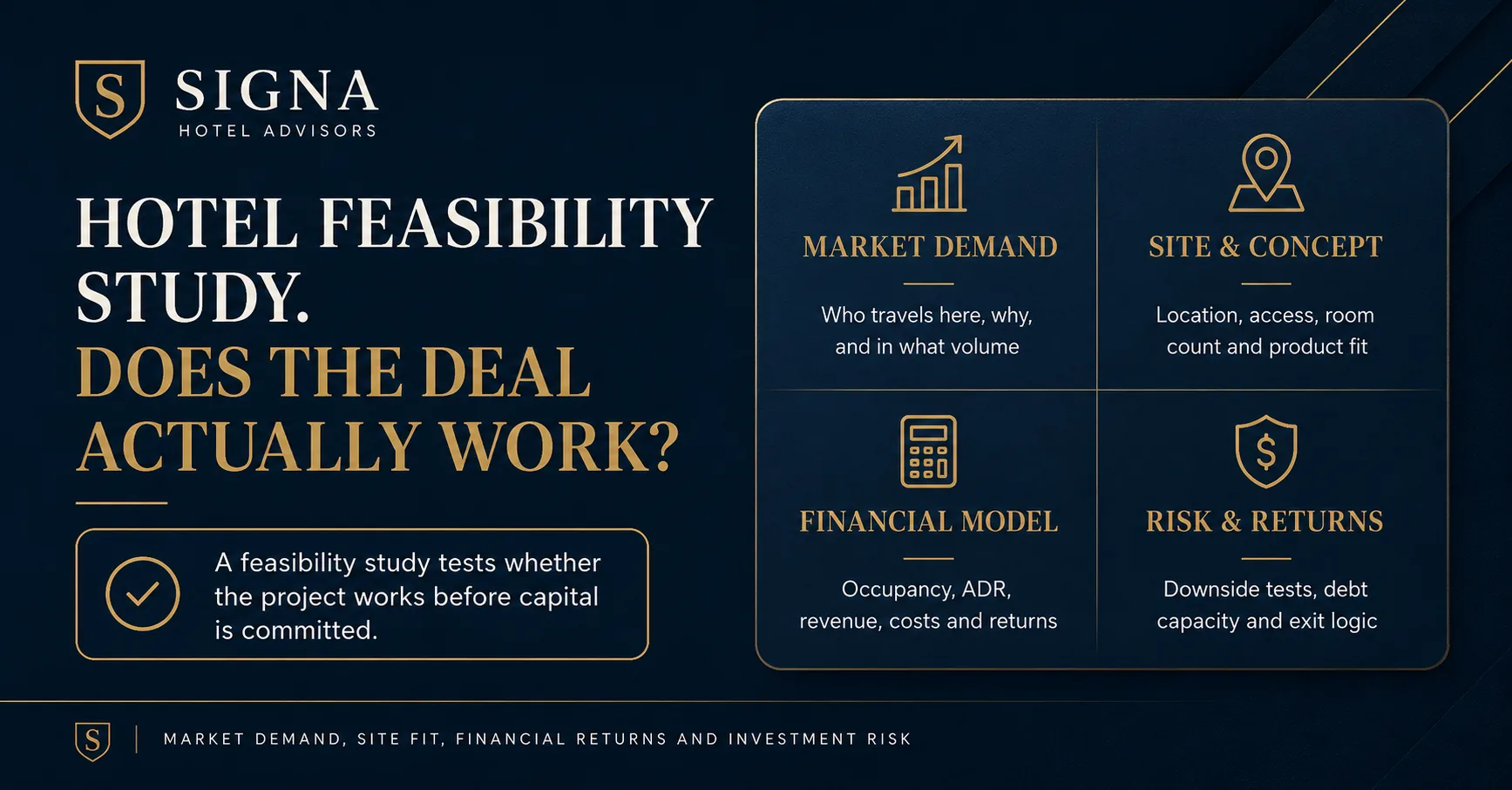
Answer in brief: A hotel feasibility study tests whether a proposed hotel development, acquisition, conversion or repositioning is commercially viable. It combines market demand, competitive supply, site and concept analysis, operating forecasts, capital requirements and risk scenarios. Its purpose is not to validate the investor's preferred answer. Its purpose is to determine whether the project works, under what assumptions, and where it fails.
Key takeaways
- A feasibility study is different from a business plan, valuation, architectural study or operator forecast.
- The study should test the market, site, concept, operating model, development cost, cash flow and downside risk as one connected investment case.
- Forecasts should be built from transparent assumptions and competitive-set evidence, not copied from an operator pitch.
- Legal, planning, title, building, environmental and licensing matters require specialist due diligence. A feasibility consultant should identify the issues but should not pretend to replace legal or technical advisers.
- The most valuable conclusion may be to reduce the room count, change the concept, renegotiate the land or acquisition price, delay the project, or not proceed.
What is a hotel feasibility study?
A hotel feasibility study is an independent assessment of whether a hotel investment can achieve commercially acceptable performance and returns.
It should answer five questions:
- Is there enough demand for the proposed hotel?
- Is the proposed product appropriate for the site and market?
- What occupancy, ADR, revenue and profit can reasonably be achieved?
- Does the projected cash flow justify the total capital at risk?
- What happens when the main assumptions are wrong?
A credible study separates evidence, assumptions and professional judgement. The investor should be able to see how the conclusion changes when demand, rate, cost, timing or capital structure changes.
What a feasibility study is not
A feasibility study is not:
- a development brochure;
- a business plan written by the project sponsor;
- a valuation of the completed asset;
- an operator's management proposal;
- an architectural concept report;
- legal or title due diligence;
- a guarantee of future performance; or
- a model built to achieve a predetermined internal rate of return.
Those documents may support the investment process, but they do not replace independent feasibility analysis.
The four pillars of a hotel feasibility study
1. Market demand and competitive supply
The study begins with demand.
The relevant question is not whether Thailand receives many tourists. It is whether enough guests will choose this specific hotel, in this micro-location, at the proposed price and throughout the year.
Demand generators
Demand drivers may include:
- leisure attractions;
- corporate offices and industrial estates;
- hospitals and medical travel;
- convention and exhibition facilities;
- airports, ports and transport hubs;
- government and education;
- weddings and social events;
- long-stay, wellness or retirement demand; and
- domestic weekend travel.
The analysis should quantify which drivers are relevant, how stable they are, and how they translate into room nights and rate potential.
Segmentation and source markets
A hotel may depend on leisure, corporate, MICE, group, wholesale, crew, long-stay or domestic demand. Each segment has a different booking window, length of stay, cancellation pattern, rate sensitivity and acquisition cost.
Source-market concentration also matters. A forecast that depends heavily on one country, one airline, one tour operator or one corporate account carries a specific risk that must be modelled.
Competitive set
The competitive set should reflect hotels that genuinely compete for the same guest, not only hotels with the same star rating.
The analysis should consider:
- occupancy, ADR and RevPAR;
- product condition and room size;
- brand and distribution strength;
- facilities and positioning;
- guest-review performance;
- channel and segment mix;
- renovation status; and
- announced future supply.
Historical data is useful, but future supply and product quality can change market share materially during the hotel's ramp-up period.
2. Site, concept and regulatory fit
A viable market does not make every site viable.
Site characteristics
The study should review:
- access and visibility;
- plot size and buildable area;
- topography, drainage and environmental exposure;
- views, frontage and orientation;
- proximity to demand generators;
- surrounding uses and nuisance risk;
- utility capacity; and
- the condition of existing buildings for acquisitions or conversions.
Concept testing
The proposed room count, room size, positioning, food and beverage, meeting space, wellness, parking and guest facilities should be tested against actual demand and site constraints.
The consultant should be willing to challenge the brief. A smaller, simpler or differently positioned hotel may generate a higher return than the owner's original concept.
Legal and technical due diligence
Thailand hotel projects may involve the Hotel Act, building-control requirements, zoning, land-title review, environmental approvals, foreign-business restrictions and local authority procedures.
The exact requirements depend on the project, location, ownership structure and building. The feasibility report should identify material approval risks and assumptions, but legal counsel, architects, engineers and environmental specialists must verify them.
3. Financial modelling and return analysis
The financial model converts market evidence into an operating and investment case.
Operating forecast
A professional forecast should normally include:
- occupancy and ADR by year;
- room revenue;
- food and beverage revenue;
- spa, meeting, parking and other revenue;
- departmental expenses;
- payroll and productivity;
- undistributed operating expenses;
- management, brand and central-service fees;
- FF&E reserve;
- insurance, tax and other fixed charges; and
- cash flow available to ownership.
The forecast period should match the investment and financing decision. Five to ten years is common, but there is no universal period.
Market penetration assumptions
Occupancy and ADR should be built from an explicit view of how the hotel will penetrate its competitive set during ramp-up and after stabilisation.
The model should explain:
- opening-date assumptions;
- ramp-up period;
- stabilised occupancy;
- ADR positioning;
- inflation;
- competitive supply;
- channel cost;
- seasonality; and
- operator or brand contribution.
Investment metrics
Depending on the assignment, outputs may include:
- GOP and GOP margin;
- EBITDA or cash flow before financing;
- net operating income;
- break-even occupancy;
- debt-service coverage ratio;
- net present value;
- project and equity internal rate of return;
- payback period;
- return on cost; and
- exit value and capitalisation-rate sensitivity.
Definitions must be stated. Hotel models often use the same term differently, particularly NOI and EBITDA.
Base, upside and downside cases
A single forecast is not enough.
At minimum, the investor should see:
- a base case reflecting the most defensible assumptions;
- an upside case showing what must go right; and
- a downside case testing weaker demand, lower rate, higher costs, delay or capital overrun.
The model should also identify the variables that have the greatest effect on return.
4. Risk assessment and investment decision
Risk analysis should connect each major risk to a financial consequence and mitigation action.
Market risk
What happens if arrivals fall, air capacity changes, a source market weakens or competing supply opens earlier than expected?
Development and execution risk
What is the effect of a six-month delay, a cost overrun, slower pre-opening recruitment or an underfunded launch?
Operating risk
Does the concept require a rate, labour model, food and beverage capture or distribution mix that has not been demonstrated locally?
HMA and operator risk
Does the operator's fee structure, budget control, performance test, area protection and termination regime protect or weaken owner returns?
Financing and currency risk
How much downside can the project absorb before breaching lender covenants or requiring additional equity? Are debt and revenue denominated in different currencies?
Exit risk
Who is the likely buyer, what HMA or leasehold constraints will remain, and what exit yield or capitalisation rate is being assumed?
What should the final feasibility report contain?
A complete report should contain:
- Executive conclusion and investment recommendation
- Project and site description
- Thailand, destination and micro-market analysis
- Demand generators and source-market assessment
- Competitive-set and future-supply analysis
- Concept and facilities recommendation
- Occupancy, ADR and market-penetration forecast
- Departmental and consolidated operating forecast
- Management and brand-fee assumptions
- Development or acquisition cost review
- Financing and return analysis
- Base, upside and downside scenarios
- Key risks, mitigations and decision conditions
- Assumption register and source list
The report should make clear what information was provided by the client, what was independently verified and what remains subject to specialist due diligence.
Thailand hotel market context in 2026
Thailand's market remains investable, but the demand and capital environment is less forgiving than a headline tourism number suggests.
The Tourism Authority of Thailand revised its 2026 international-arrival outlook in April 2026 to approximately 30 to 34 million, citing demand volatility, air-connectivity constraints and energy-price risk. This replaced higher earlier forecasts.
JLL reported that Thailand hotel transactions reached THB 26.4 billion in 2025, almost double the ten-year historical average, with more than 75% of volume concentrated in Bangkok. JLL expected activity to normalise to approximately THB 13 billion in 2026.
In Bangkok, JLL reported broadly stable RevPAR year on year in the first quarter of 2026, while approximately 5,000 new rooms were anticipated by year-end. This combination reinforces the need to underwrite individual locations and concepts rather than assuming market-wide growth will carry every project.
How long does a hotel feasibility study take?
As a practical planning allowance, a full study commonly takes several weeks once the consultant has complete data, site access and a confirmed scope. Four to eight weeks is a reasonable planning range for many assignments, while complex mixed-use, resort, lender-grade or multi-site work can take longer.
This is not an industry tariff or guarantee. The timeline should be agreed against specific deliverables.
How much does a hotel feasibility study cost in Thailand?
There is no reliable Thailand-wide price range that applies to every project.
Fees depend on:
- location and data availability;
- property type and room count;
- development, acquisition or repositioning scope;
- lender requirements;
- depth of primary research;
- financial-model complexity;
- site visits;
- operator or brand evaluation;
- valuation requirements; and
- legal, technical or environmental work included or excluded.
A low fee is not useful if the report omits site research, competitive data, operating detail or downside testing. Compare scope, methodology, team and deliverables, not only price.
When is a feasibility study required?
A feasibility study should be commissioned before:
- a greenfield hotel development;
- a hotel acquisition based on seller projections;
- conversion of office, residential or other real estate to hotel use;
- a major repositioning or category change;
- selection of a brand or operator that changes the economics;
- application for development finance;
- entry into a joint venture;
- commitment to a long leasehold structure; or
- major capital expenditure intended to change market positioning.
The best time is before the design and capital structure become difficult to change.
How to choose a hotel feasibility consultant
Ask:
- Do they have current experience in the specific Thai destination and hotel segment?
- Will they conduct independent primary research?
- Can they challenge the proposed room count and concept?
- Are the financial assumptions transparent and editable?
- Do they understand hotel operations, distribution and HMA fees?
- Will they separate verified facts from assumptions?
- Can they explain the downside case clearly to an investment committee or lender?
- Are conflicts with operators, brands, brokers or developers disclosed?
Frequently asked questions
Is a hotel feasibility study the same as a hotel valuation?
No. Feasibility tests whether a proposed investment can work. Valuation estimates the value of an asset or interest at a particular date. Some assignments include both, but the methods and conclusions are different.
Can an operator prepare the feasibility study?
An operator can provide a forecast and brand case. The investor should still obtain independent analysis because the operator is competing for the management or franchise appointment.
Does a feasibility study guarantee financing?
No. It supports underwriting, but lenders make their own decisions and may require valuation, legal, technical and sponsor due diligence.
Should a hotel acquisition have a feasibility study?
Yes, particularly where the acquisition thesis depends on renovation, rebranding, operator change, revenue uplift or cost reduction.
What is the biggest warning sign in a feasibility model?
A forecast that reaches the target return only through aggressive ADR growth, rapid stabilisation, low payroll, understated fees or an optimistic exit value.
Conclusion
A hotel feasibility study is an investment-control tool.
It should tell the owner whether the market, site, concept, operating model and capital structure work together. It should also expose the assumptions that could destroy the return.
The objective is not to produce a positive report. The objective is to make the correct capital decision before the cost of changing direction becomes material.
Sources and methodology
Market and legal references were reviewed on 14 June 2026.
- Tourism Authority of Thailand: 2026 tourism outlook recalibrated to 30 to 34 million arrivals
- JLL: Thailand real estate and hotel investment outlook for 2026
- JLL: Bangkok Hotel Market, Q1 2026
- HVS: Hospitality Feasibility and Market Studies
- DLA Piper REALWORLD: Development permissions and zoning in Thailand
- Thailand BOI One Start One Stop Investment Center: Hotel Business
Signa Hotel Advisors provides independent hotel feasibility studies, market analysis and financial modelling across Thailand and Southeast Asia. Contact Signa before committing land, acquisition capital, development expenditure or an operator agreement.
Continue reading
- Reviewing Your Annual Hotel Budget: An Owner's Checklist
- 10 Numbers Every Hotel Owner Should Check in the Monthly Report
- Capture, Not Dwell: What the RevPAG Argument Misses in Thailand
- The Budget That Arrives After You Sign: What Hotel Owners Are Never Told About Brand Costs
- Hotel Loyalty Programmes: What Owners Need to Test Before Signing
- Book Direct, But Who Captures the Value?
- Hotel Operator Selection in Thailand: An Owner's Guide
- Hotel Asset Management in Thailand: An Owner's Guide
- Signa hotel feasibility & advisory services
Need a confidential review of your hotel?
Signa Hotel Advisors represents hotel owners across Thailand and Southeast Asia on asset management, feasibility, operator selection and HMA negotiation.
Speak with our team